Adversarial Networks: on Joseph Nechvatal
by Katherine Williams
for Impulse Magazine
December 2025
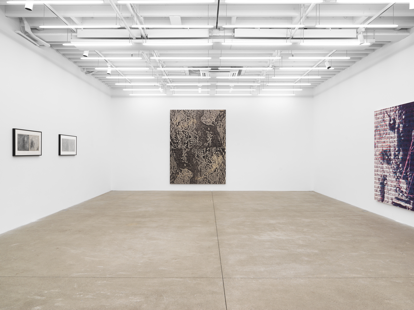
Information Noise Saturation, Magenta Plains, NYC
In Joseph Nechvatal’s diptych graphite drawings, figures
navigate a world without coordinates. Amidst Mind of the World (1984),
an armored, oversized, machinic assemblage of a
soldier charges toward little but apparition; on the left drawing, partial
outlines of bodies collide with a haphazard array of jagged graphite lines,
concentrated in the ominous, barely visible gaze of a man’s face at the center.
In False Friends (1982), policemen scrutinize a protester and stand firm
amidst pop-cultural figurative sketches. In earlier drawings by Nechvatal, done with graphite on paper, similar figures of
gonzo caricature appear, but the works on display in Information Noise Saturation
at Magenta Plains show a texture of overload obscuring the legibility of
their form.
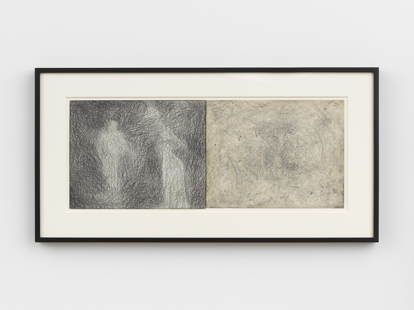
No Future, 1983 Graphite on paper Diptych, Overall 11 x 28 in
Nechvatal’s compositions approach something like
narrative, however fragmented and mercurial, filled with characters who would
be right at home in noir and detective fiction were they not thrown into the
information landscape of the 1980s. The drawings depict a terrain not quite a
cyberspace (a term coined amidst the years during which the works were made),
in which axes appear as simulacra, but an imaginary geography without
landmarks, where figures emerge in associative disunion. That absence of
landscape is a lack endemic to Nechvatal’s post-A
Thousand Plateaus world—writing in Artforum
in 1984, Kate Linker noted that postmodernism’s “empty discourse of
surfaces” leads to the “erosion of all coordinates of value,” a haphazard
disintegration in which individuals are left to decode the irrational
simultaneity of a greyscale information space.[1] In Nechvatal’s approach, the consequences of such erosion are
best expressed as a density. Skeptical of pop art, whose absorption of mass
media Nechvatal might consider unequipped to address
consumer fetish, he once described it as “art
noise,” which “counters the effects of our age of simplification.” Noise
is an appropriate pictorial language to accommodate the proliferation of
information technology, visual media, and financialized markets that
characterized the 1980s—but it’s the delicacy of Nechvatal’s
marks, however condensed they may become in whole, that best suggests a more
nuanced sentience to the scene.
The
three larger-scale works in the exhibition, made a few years after the
graphite drawings, attend to Nechvatal’s “Informed
Man” character, who lends their moniker to his Profusely Informed Personage (1986).
A statue of Babalú-Ayé, a popular orisha
in Santería worship, is covered in and set against a
background of scans of figures taken from popular magazines, layered with
drawing by Nechvatal. His photograph of this scene
was then taken up by an imaging service for billboard production, which
airbrushed the digital image onto canvas. In this process, Nechvatal’s
work invokes a similitude to other considerations of the automatic: Wade Guyton’s
inkjet prints, with the wrinkled imprints of a machine’s errors and will, or
the fuzzy outputs of Matthias Groebel’s
airbrush painting machine. The spray method is attractive in that it joined
(and predated others in) a long genealogy of artists using automation to
consider the withdrawal of the painter’s hand over the past half-century. Here,
though, that withdrawal is interesting only to the extent that it bears on the
character—that the informed man is being subjected to yet another step of image
production, blurring the distinction between the fictional world in which he
resides and the real method of his construction.
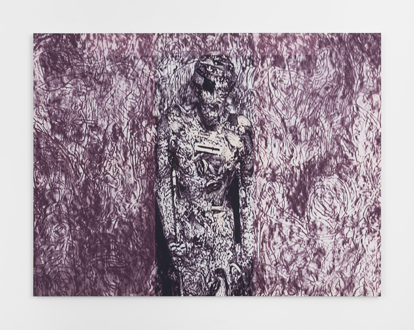
Profusely Informed Personage, 1986 Computer-robotic assisted acrylic painting on
canvas 72 x 96 in
Between
1997 and 2002, Jack
Pierson utilized a similar acrylic spray technique for billboards in
a series of works; both foreground the printing marks and pixelation,
which render the scene mediated, but Pierson’s images are airy and dislocated,
while Nechvatal’s works with his Informed Man dip
into a register of violence. The figure is a carcass, the rot of which is
conveyed in the accumulation of detritus upon its form. What is he covered in?
The same image of the Santería statue constitutes Infinite
Apocalyptic Messenger (1987), focalized to the scale of his head and
shoulders. Layered atop the strained figure in an all-caps, imprinted
typewriter font is text from the aforementioned Artforum
essay on simulacra, and certain phrases stand out: “grounds for objective truth
have been annihilated,” “no longer possible,” “authentic and inauthentic,”
“massive fabrication.” The essay reads Baudrillard
and Debord, examining the loss of indexicality
and reference—that “erosion of all coordinates”—as third-order simulacra
settled in at the dusk of the twentieth century. If theorists of the hyperreal
tended to focus on glossy surfaces, spectacular effects, and shining
ahistorical artifice, though, Nechvatal’s informed
personage, weighed down by such mediatization, shares
less in common with the Disneyland phenomena of simulacra that captivated Baudrillard and Umberto Eco.
The
figure is not so much a model of excess’s gleaning emptiness than of the
density of the zombified form which it saturates:
certainly, the anguish in his hunched shoulders, in the burden of information
he carries without say, is a kind of body horror. One thinks of N. Katherine Hayles’s observation that posthumanism
erases the distinction “between the biological organism and the informational
circuits in which it is enmeshed,” and of the height of cyberpunk, concurrent
with Nechvatal’s work, seeking to represent the
disfiguration and contamination endemic to early onset information society.[2]
The body of the 1980s, absorbing electromagnetic waves and nuclear radiation,
was antimaterialist and permeable—Nechvatal’s
figure is a useful character, then, for recalling a kind of somatic fatigue. In
this, the Informed Man is a more neo-expressionist cousin to something like Ed Paschke’s
televisual figure in Nervosa (1980): a body as seen through an
interface, through a strange grid of uncanny exposure in the early days of
screen glow, moire distortions, raster lines, and
channel surfing. However attractive the rhizomatic
epistemology of poststructuralism may be, here the physical consequences are
given their due.
A
later work, Without Chains (1990), is a somewhat abstracted composition
of the Informed Man as Narcissus, gazing upon his unfocused reflection—a
darkened greyscale tone, similar to topography from a distance, renders him
almost unrecognizable. There’s certainly humor in the reflection now, being
that of an actual statue, not merely a seductive likeness to marble. If it
functions as an intimation of the frayed postmodern subject with no exalted
Renaissance self left to lose to idolatry, it insists
equally on the possibility of a profusely informed self-recognition. The scene
is reflected along a line which runs across the middle of the canvas, an
imprint of Nechvatal’s hand in the printing process:
intentional or not, it underscores the politics running against the ostensibly
totalizing force of visual noise. (Without Chains was made the same year
the Gulf War began, which was described by Frances Dyson as a conflict in which
the consequences of action were seen through “the snow of signal termination.”)
Together, the three depictions of the Informed Man are a starkly hopeful
narrative triptych, as though his persona may be wrenched back into the
register of affect, once said to have been traded for surface in postmodernism.
It becomes a gambit that the suggestion of subjectivity, however warped behind
an interface that seeks to level it, remains alive somewhere in this deterritorialized plane.
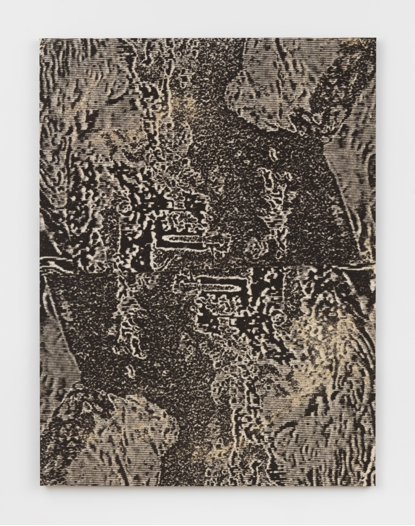
Without Chains, 1990 Computer-robotic assisted acrylic painting on
canvas 96 x 72 in
The
informed man looks quite a bit like Charles Csuri’s Sine Curve Man (1967), an early
figurative computer drawing completed by an IBM 7094. Thin, clean lines
constitute Csuri’s drawing, which was completed with
a drum plotter, and are prescient more so of a treachery undergirding
technocratic efficiency. But both faces collapse and sink, rendered grotesque
by the necessity of information technology in their construction. The disfigurative portrait seems to remain an ever-attractive
strategy of picturing the subject in the territory of his age. For Nechvatal, this might be the seeds of a scattered and
profuse information society, in which a dense and disheveled horror of
figuration defends the status of the subject. At a time in the mid-80s when
computer graphics were leaning towards metallic seductions and a rudimentary
palette (popularized on MacPaint and Paintbrush for
Windows), it’s an assertion that living with transmission and mediation is not
about surfaces but about obfuscated depths. As contemporary artists like
Phillip Schmitt foreground the opaque, disembodied character of machine
learning, one finds an ambivalent relief in figuration.
There
is an initial longevity to the Informed Man series, with its intimations of
screen media and boundary-melting emulsion of body and technology. It’s a
consideration taken up with device after device, up through works like Tishan Hsu’s distorted topographical compositions over the
past few years. A body embedded in information, native to representational
strategies of the 1980s, is still a compelling landmark.
But
if the raw material of noise was once central to the task of visualizing (and,
it’s implied, evaluating) information’s excess, its status is more volatile
than it was in the age of radio waves and television. It is less the “stuff”
that penetrates and degrades the human body living amidst nuclear proliferation
than that which constitutes the image itself: the addition and removal of
noise—forward and reverse diffusion—furnishes the training process for
generative models, which learn to make images by finding forms in randomness.
The idea, as it was put in early papers on these models, is to destroy
structure in data, such that it is possible to put it back together again.
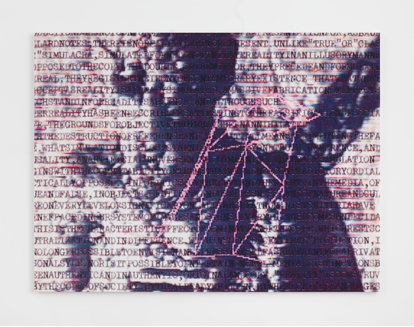
Infinite Apocalyptic Messenger, 1987 Computer-robotic assisted acrylic painting on
canvas 72 x 96 in
Nechvatal’s triptych is useful, then, in thinking
about what kind of form might be constituted in such a violent array of
randomness. But it’s curious that this series on the Informed Man, ostensibly
apropos in their attendance to the deteriorative effects of immersion in screen
media, ends up yielding to the more reticent fury of Nechtaval’s
graphite drawings. The uneven lines and variable shades invite viewers to see
noise itself as a process of mark-making. Before classical empiricism defined
information as the external “stuff” of experience, it meant a conferral of
form, a process of shaping—one suspects the drawings get closer to that
significance. The Informed Man may be likened to a figure made in noise’s timestepped removal of perceptual features, but the
alternative allure of the drawings lies precisely in their method, not so much
about reproduction as about entropy. In foregrounding form over affect, they
are slyly tenable.
There
is an irony here, a strange inversion: the hand involved in the diffusion
happening in these drawings is now a recursive algorithm, while the automated
method invoked in the acrylic work feels based in a visual culture both
valuable and overfamiliar. All of Nechvatal’s work
contains a classic tension between the profuse disorder of experience and the
forms that order that chaos. It is the potential of the drawings, though, that
most stands out: in thinking not only about how noise may confer and obscure
form, but how both noise and form are manipulable—spun
and undone, added and removed, legible and then not. Graphite may no longer be
a paradigmatic tool by which that process occurs, but the artificial forms that
constitute new images find a curious ancestry in that lineage.
Joseph Nechvatal: Information Noise
Saturation, Magenta Plains, 149 Canal Street, NYC, November 6 through
December 20, 2025.