Information
Noise Saturation
Magenta Plains
149 Canal Street NYC
November 6–December
20, 2025
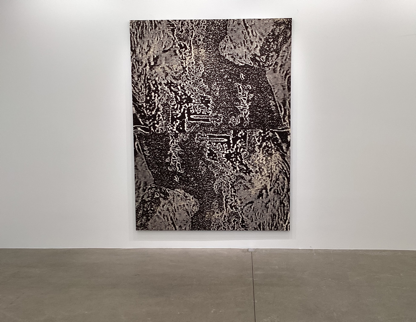
Without Chains (1990) 267x203 cm (96x72
in) computer-robotic
assisted acrylic painting on canvas
Information
Noise Saturation
is a historical exhibition by Joseph Nechvatal that
focuses on computer-robotic assisted acrylic paintings and graphite drawings on
paper made from 1982–1990. This crucial period in the artist’s practice marks a shift in his work from an earlier,
minimal aesthetic toward a complexification brought
on by the advent of the personal computer and the internet.
A concern
with information noise and media overload form the backbone of Nechvatal’s thematic direction in these
works, as he attempts to grapple with some of the defining postmodern
challenges of the last forty years: nuclear proliferation, the spread of
disinformation, and the rapid integration of large language models into our
society.
Joseph Nechvatal arrived in New York in 1975, pursuing graduate
coursework in philosophical aesthetics at Columbia University and working
part-time as an archivist at the Dia Art Foundation.
He quickly became embedded in the vibrant scene of the East Village,
participating in the artist cooperative Colab and
aiding in the founding of radical artist-cum-activist space ABC No Rio in 1980.
He frequently exhibited at the Nature Morte Gallery,
which was known for exhibiting deconstructionist conceptual photography,
sculpture, and paintings by artists such as Gretchen Bender, Jennifer Bolande, Sherrie Levine, Ken Lum,
Allan McCollum, Peter Nagy, Cady Noland, and Steven Parrino.
Further exhibitions took place at Brooke Alexander Gallery.
In 1985 a
technician introduced Nechvatal to the
computer-assisted technology he would later use to make his conceptual
paintings. Throughout the decade, Nechvatal’s practice straddled both neo-expressionism and
post-modern appropriation. (See Frank, Patrick. 2024. Art of the 1980s. Walter de Gruyter GmbH & Co KG. pgs. 7–8) However, Nechvatal’s consistent political praxis and commitment to using
drawing and painting as tools to communicate ideas beyond an aesthetic concern
sets him apart from many of his contemporaries.
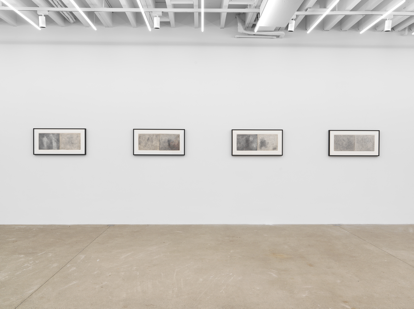
Nechvatal’s drawing practice from this
period forms the basis for his conceptual paintings and share a common
aesthetic: each work is a diptych of dense graphite edge to edge. Nechvatal created these works by laying paper on a
translucent table and lighting from underneath, allowing him to achieve a
layered surface of marks while working at them intensively with a graphite
block until the surface of the work achieved an almost uniform smoothness.
While at first glance many of these images appear to be purely abstract,
imagery appears with closer inspection; in No Future (1983), a police
officer looks on haughtily while a civilian cowers beneath a fighter jet. The
greyscale shading of these works focuses the viewers’ attention on line and
mark, emphasizes the immersive nature of these images, and stands in contrast
to the pop color palette of many of his contemporaries.
In 1986, Nechvatal began using image enlargement technology (first
developed as a method for producing billboards) to digitize and magnify his
drawings into acrylic paintings that are layered in a web-like, labyrinthian manner. Invented in Japan and brought to the
United States by the California-based company Computer Imaging Services, this
process involved airbrush-painting images directly onto canvas from
photochemical transparencies. This method expanded the bounds of his
information-overload aesthetic, both in terms of scale and ambition. Works such
as Profusely Informed Personage (1986) incorporate a three dimensional Lazarus
figure wrapped entirely in xeroxes of Nechvatal’s drawings and anti-war protest posters in an
immersive visualscape of chaotic marks. This mediated
technology offloaded the primacy of the artist’s
hand, foregrounding the idea and its genesis. In this sense, Nechvatal is aligned with Sol Lewitt’s view that a painting can be a repeatable, temporally
unbound object, as opposed to a record of a creative encounter with material. In
Lewitt’s words, “the idea becomes a machine which makes the art.”
With
these computer-assisted paintings and graphite drawings, Nechvatal
sought to evoke the ideological manipulation at the center of mass media “infotainment” during one of
the most dangerous moments of the Cold War, as the Reagan administration
ratcheted up nuclear tensions with the Soviet Union. Nechvatal’s “aesthetic
of subtle excess,” in his own words, functions in opposition to the pop imagery
and media designed to obfuscate the bellicose rhetoric of this period. These
works were borne from Nechvatal’s
concern with nuclear apocalypse, but in today’s
world, they take on a new light. In our contemporary society of ideological
excess and amidst an unmitigated hurtle toward artificial
intelligence, an
ill-understood technology with the potential for vast economic and ecological
disruption, Nechvatal’s
work stands as a prescient warning.
~ Magenta Plains
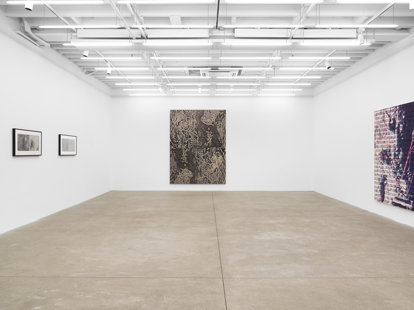
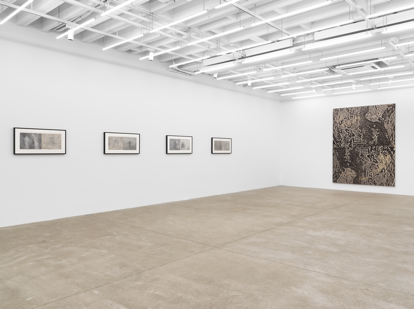
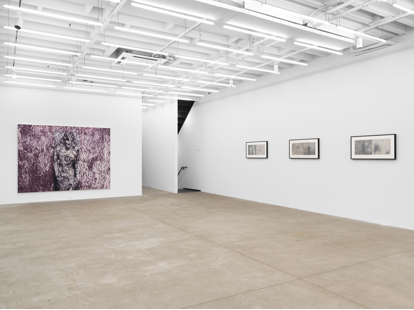
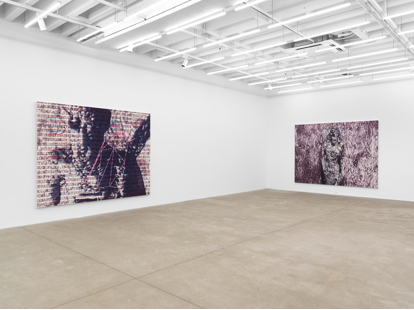
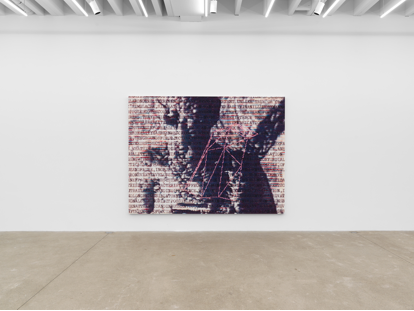
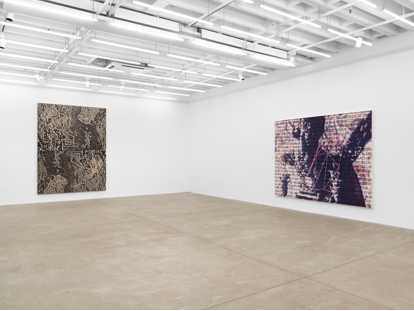
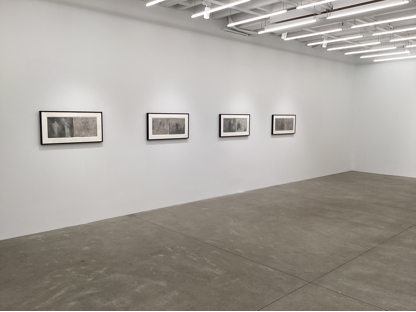
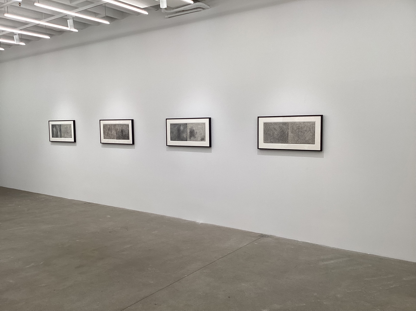
works in the show
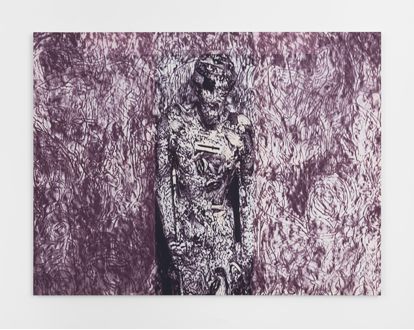
Profusely
Informed Personage
(1986) 182.9x243.8 cm (72x96 in)
computer-robotic assisted
acrylic painting on canvas
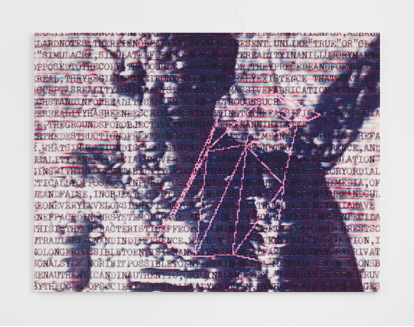
Infinite
Apocalyptic Messenger
(1987) 182.9x243.8 cm (72x96 in)
computer-robotic assisted
acrylic painting on canvas
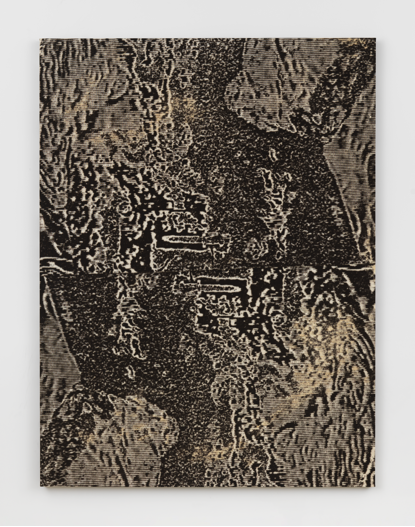
Without Chains (1990) 267x203 cm (96x72
in)
computer-robotic assisted acrylic
painting on canvas
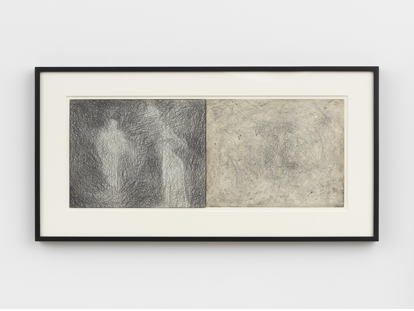
No Future (1983) graphite on paper
diptych, overall 11 x 28 in
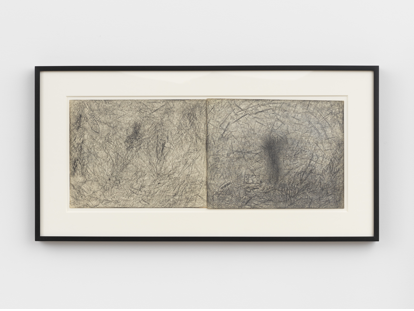
Destruction (1981) graphite on paper
diptych, overall 11 x 28 in
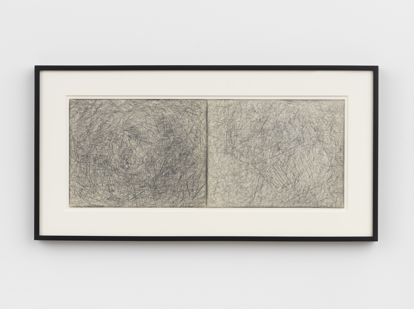
False Friends (1982) graphite on paper
diptych, overall 11 x 28 in
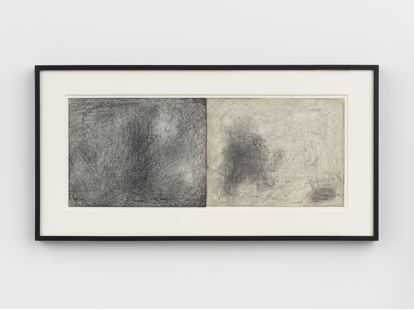
Mind of the
World (1984)
graphite on paper diptych, overall 11 x 28 in